Dice probabilities and a 13.87% edge in Jhandi Munda
- Provider
- JILI Games
- RTP
- 97.14%
Jhandi Munda is a traditional dice game of chance that relies on the independent outcomes of multiple dice rolls. In adapting this classic to a digital format, the software studio JILI Games presents a Random Number Generator (RNG) table game that preserves the original six-dice mechanics. Because the game involves no drawing cards or spinning reels, the entirety of its mechanics is rooted in pure binomial probability. This review serves as a mathematical deep-dive into how the six-dice system functions, detailing the true odds of matching symbols and the resulting house edge.
What Jhandi Munda is
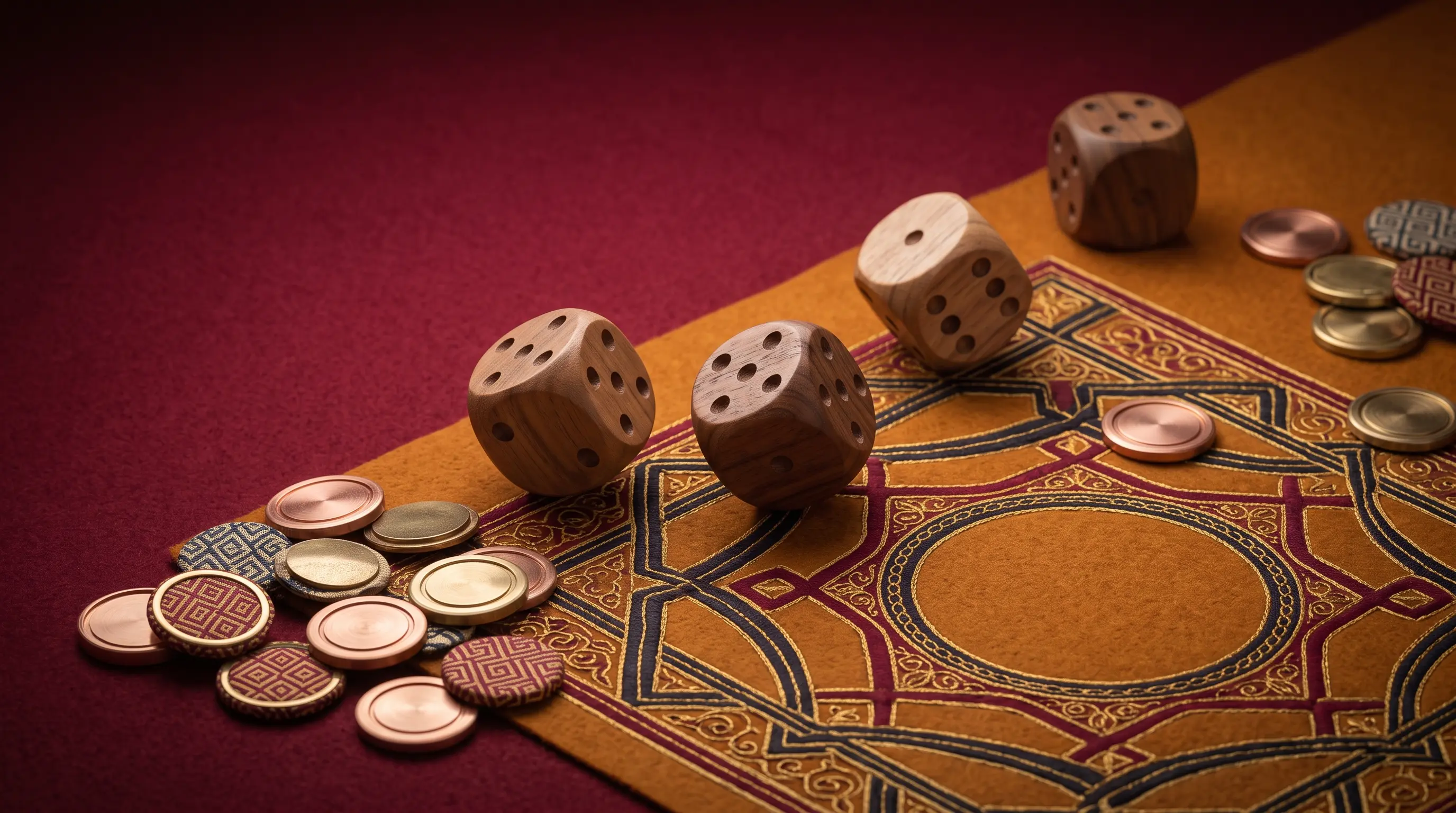
Jhandi Munda is a fixed-odds betting game played with six specially marked dice. Rather than featuring numerical pips (1 through 6), each die is printed with six distinct symbols. The objective is strictly predictive: the player wagers on which specific symbol will land face-up most frequently across the six dice in a single roll. There are no player decisions to be made once the dice are cast, making it a game of unfiltered probability.
Where the game comes from
Understanding the cultural origin of the game provides necessary context for its unique symbols and structure. Jhandi Munda originated in the Indian subcontinent and remains a deeply rooted cultural tradition, particularly in India, Nepal (where it is often known as Langur Burja), and Bangladesh. Historically, it is a social street game heavily associated with major autumn festivals like Diwali, Dashain, and Tihar. The transition to a digital format by studios like JILI standardizes these regional festival rules into a strict mathematical model.
How a round works: the dice and the symbols
The physical mechanics of the digital version replicate the traditional setup precisely.
The Dice Setup: The game utilizes exactly six independent dice.
The Symbols: Each of the six dice features the exact same six symbols. While designs can vary slightly, the standard set includes the Heart, Spade, Diamond, Club, Face (or Crown/Munda), and Flag (Jhandi).
The Roll: Once bets are finalized, the RNG software simultaneously "rolls" all six dice, generating six independent outcomes.
Placing bets on symbols
The betting interface is exceptionally straightforward. The board displays the six available symbols. Players can place their wagers in game units on one or more of these symbols. Because each symbol has an equal 1 in 6 chance of appearing on any given die, the baseline mathematical probability for every betting option on the board is completely identical.
Payouts and how they scale with matches
The defining characteristic of six-dice Jhandi Munda is its payout ladder. Because rolling six dice means a single symbol can appear multiple times, the payouts scale based on the number of exact matches. In the standard traditional ruleset utilized by digital platforms:
0 Matches: The wager is lost.
1 Match: The wager is lost. (This is the critical rule that establishes the house edge).
2 Matches: Pays 2:1 (The player wins 2 units in profit).
3 Matches: Pays 3:1.
4 Matches: Pays 4:1.
5 Matches: Pays 5:1.
6 Matches: Pays 6:1 (Some specialized digital variants may attach a jackpot bonus to a 6-match outcome, but 6:1 is the mathematical baseline).
The probability behind each outcome
To understand the game's volatility, one must analyze the binomial distribution of rolling six dice, where the probability of hitting a specific symbol on a single die is exactly 1/6 (or roughly 16.67%).
| Number of Matches | True Mathematical Probability | Outcome |
|---|---|---|
| 0 Matches | 33.49% | Loss |
| 1 Match | 40.19% | Loss |
| 2 Matches | 20.09% | Win (2:1) |
| 3 Matches | 5.36% | Win (3:1) |
| 4 Matches | 0.80% | Win (4:1) |
| 5 Matches | 0.06% | Win (5:1) |
| 6 Matches | <0.01% (1 in 46,656) | Win (6:1+) |
The core takeaway from the mathematics is that a player has a 73.68% chance of hitting zero or one match, resulting in a complete loss of the wager.
House edge in this version
The house edge is derived directly from the probability table and the payout scaling.
Because every symbol operates on the exact same probabilities, the house edge is identical across all main bets on the board. When factoring in the standard payouts (losing on 0 and 1, winning 2:1 up to 6:1 on multiples), the mathematical expectation yields a house edge of 13.87% (an RTP of 86.13%).
This edge exists entirely because the most frequent outcome (1 match, occurring 40.19% of the time) results in a loss rather than a push. While the potential for 6:1 payouts provides volatility, the high 13.87% edge makes Jhandi Munda a fundamentally high-cost game over an extended session compared to standard casino table games like Baccarat or Blackjack.
How the digital version compares with the traditional game
The transition from a festival street game to a digital RNG format ensures mathematical perfection.
True Independence: In physical settings, biased dice, uneven rolling surfaces, or specific throwing techniques can subtly alter probabilities. The JILI digital version utilizes certified RNG, guaranteeing that every single die roll is a completely independent event.
Speed: Digital resolution is instantaneous. A player can complete dozens of rolls in the time it takes to organize a single round in a traditional setting, drastically accelerating the application of the 13.87% house edge against the bankroll.
Strategy reality
Due to the independent nature of the RNG and the fixed payouts, skill cannot influence the outcome of Jhandi Munda.
Backing Multiple Symbols: Players often attempt to hedge their bets by placing wagers on two, three, or even all six symbols simultaneously. While this increases the frequency of seeing a payout animation, it does not alter the underlying mathematics. Betting on three symbols simply exposes three times the capital to the same 13.87% house edge. It reduces short-term variance but accelerates long-term losses.
Pattern Tracking: Digital versions may display a history of recently winning symbols. Because the dice are mathematically reset for every roll, past outcomes hold zero predictive value for future rolls.
Regulatory Compliance & Safe Play
Bankroll discipline is essential in high-edge formats.
This game and the accompanying review are intended strictly for individuals aged 18 and older. The combination of rapid RNG resolution and a 13.87% house edge means that capital can be depleted quickly. Players must utilize strict session limits, pre-determine an acceptable loss threshold, and view the game entirely as a form of cultural entertainment rather than a viable method for generating mathematical profit.
Verdict
JILI Games' Jhandi Munda is a flawless mathematical recreation of the traditional six-dice festival game. It strips away the physical variables to present the pure binomial probabilities of the format. While the visual aesthetic is vibrant and pays homage to its cultural roots, players must engage with a clear understanding of the math: the requirement to hit two matches just to secure a payout creates a steep 13.87% house edge. It is an excellent digital preservation of a classic, but one that requires strict bankroll management to play responsibly.