Card and Board Games: Analyzing Digital Adaptations
Games in this category
 18+
18+7 Up 7 Down
7 Up 7 Down
Blaze Gaming95.00%
7 Up 7 Down is a traditional dice game of probability with origins as a casual street and festival game in the Indian subcontinent.
 18+
18+Dragon Tiger
Dragon Tiger
Habanero96.27%
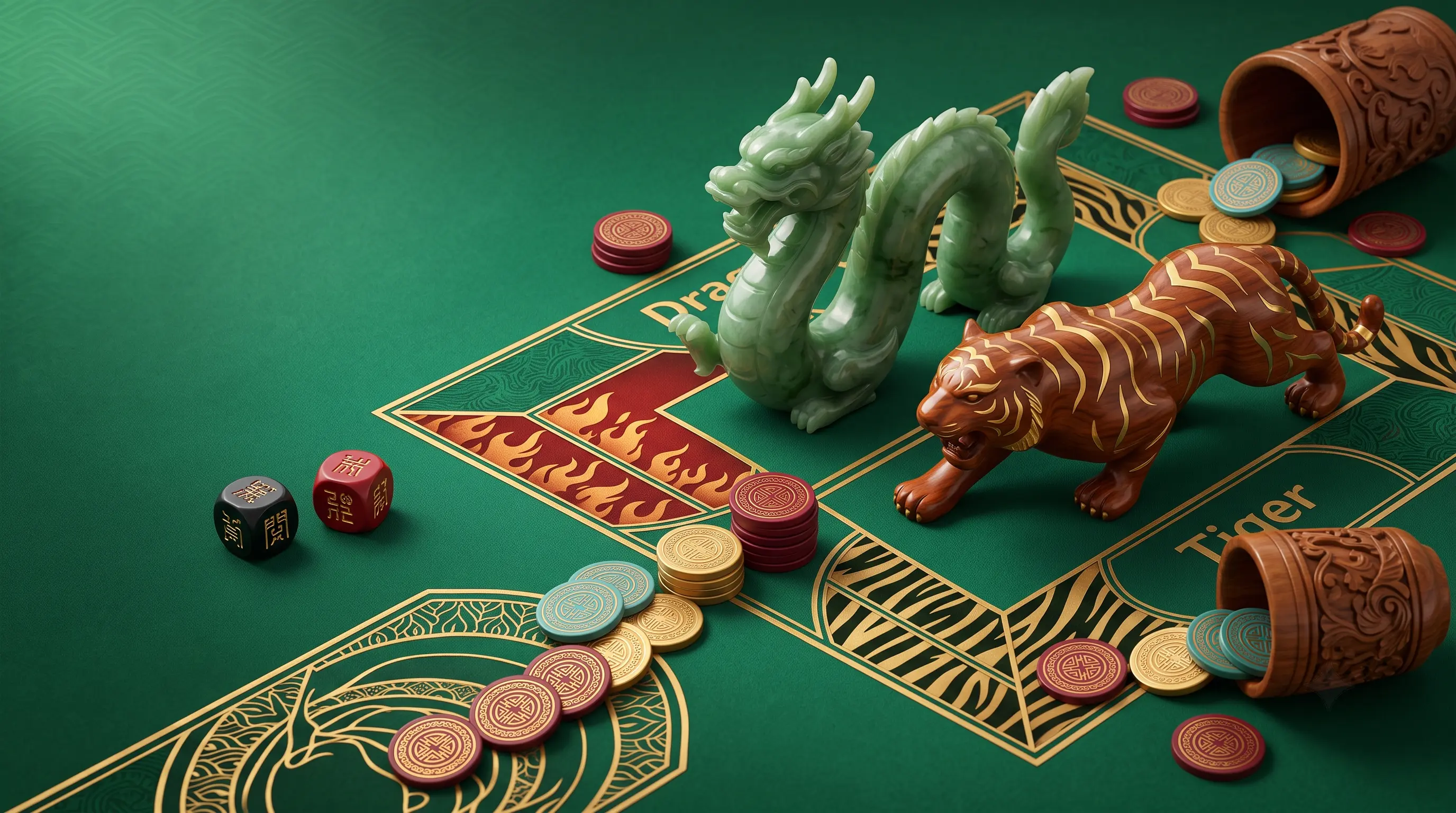
Dragon Tiger is widely considered the most structurally simple casino card game available.
 18+
18+Dragon Vs Tiger
Dragon Vs Tiger
Blaze Gaming96.00%
The comparative simplicity of the traditional Asian card game Dragon Tiger means that the underlying mathematics dictate the entire player experience.
 18+
18+Golden Mahjong Deluxe
Golden Mahjong Deluxe
Funky96.50%
Mahjong is a traditional Chinese tile-based game historically requiring four players, complex hand assembly, and deep tactical strategy.
 18+
18+Jhandi Munda
Jhandi Munda
JILI Games97.14%
Jhandi Munda is a traditional dice game of chance that relies on the independent outcomes of multiple dice rolls.
 18+
18+Ludo Quick
Ludo Quick
JILI Games95.00%
Ludo is a universally recognized board game with deep historical roots, evolving directly from the ancient Indian game of Pachisi.
 18+
18+Teen Patti
Teen Patti
One Touch97.50%
Teen Patti is one of the most prominent traditional card games globally, relying heavily on hand reading, bluffing, and risk assessment.
This routing hub organizes our coverage of the card and board games category. We provide structural breakdowns and mathematical reviews for a targeted inventory of 7 titles developed across 5 different studios. Our objective is to detail how these distinct software engines operate and route you to the specific, full-length review for each title.
What this section covers
This category spans a diverse range of software formats, including poker variants, dice mechanics, and digital board games. Because these formats originate from entirely different physical counterparts, they do not share a single, unified mechanical engine. Instead, this section categorizes them as digital adaptations of established tabletop formats, focusing on how their physical rulesets have been translated into random number generator (RNG) software.
Traditional games in digital form
The titles in this section are primarily digital adaptations of real-world games. Formats such as Teen Patti, Dragon Tiger, Jhandi Munda, and Ludo carry distinct cultural origins and long-standing historical rulesets. Describing this heritage provides necessary context for understanding the foundational mechanics of the software. The digital versions preserve these traditional rules while utilizing certified RNG technology to facilitate the draw, roll, or dealing mechanisms, ensuring that the historical format functions securely in a digital environment.
How card and board games differ from slots
The mathematical structure of these formats differs fundamentally from standard slot engines. While a slot typically operates on a single, fixed Return to Player (RTP) metric for the entire game, card and board games feature variable mathematical models.
In these formats, the house edge often changes depending on the specific bet type placed. Furthermore, unlike the purely passive spin of a slot, certain card and board adaptations are partly skill-influenced, requiring active decision-making that directly impacts the theoretical return. For the exact per-bet mathematics and optimal return strategies, we direct readers to the individual reviews.
The games reviewed here
Our current inventory within this section comprises 7 distinct titles from 5 software studios. Each link below routes to a dedicated review that deconstructs the specific mechanics and probability models of the respective game:
Teen Patti: A digital adaptation of the traditional three-card poker variant, analyzing hand rankings and blind bet mechanics.
7 Up 7 Down: A simple, probability‑driven dice game where players wager on whether the total will land below 7, above 7, or exactly 7. The format delivers rapid rounds with fixed‑odds outcomes, making it a fast, low‑complexity betting experience built entirely around statistical expectation rather than multipliers or arcade mechanics.
Dragon Tiger: A rapid, two-card draw format focusing on straightforward high-card probability.
Jhandi Munda: A classic dice game adaptation, breaking down the payout structure across six symbols.
Ludo Quick: A digital translation of the strategic cross-and-circle board game, focusing on dice-based movement algorithms.
Dragon Vs Tiger: A fast‑paced, two‑outcome card game built around instant resolution and minimal rules. The design focuses on pure probability: players wager on which side reveals the higher single card, creating a rapid, high‑volatility experience without secondary mechanics.
Golden Mahjong Deluxe A tile‑matching arcade game that adapts classic mahjong patterns into a reward‑driven format. Payout potential scales with successful chain clears, blending puzzle progression with incremental risk and bonus multipliers.
Playing responsibly
Card and board games often feature rapid betting rounds and variable odds that require strict bankroll management. Because certain bets carry a significantly higher house edge than others, it is critical to understand the mathematical models before engaging. We strongly advise setting clear limits on your digital sessions. For neutral, comprehensive information on maintaining control, please review our responsible gambling guidelines.
FAQ
Are digital card and board games purely based on luck?
While the deal or dice roll is dictated by an RNG, the level of player input varies. Some formats are entirely based on random chance, while others are partly skill-influenced and require strategic decision-making that affects the outcome.
Do these games have a single RTP like a slot machine?
No. Unlike slots, these formats typically feature a different house edge for each specific bet type or side wager available on the board.